William Malet — "Companion of the Conqueror"
William Malet, or Guillaume, as he may have been called, "Sire de Graville", came from Graville Sainte Honorine between Le Havre and Harfleur, in what is today the French province of Normandy. He is said to have had a Norman father and an English mother, and had some sort of association with King Harold of England before the conquest. William, through his English mother, may actually have been related to King Harold, and also to the well known Lady Godiva. It is also possible that William and Harold were both Godfathers of Duke William of Normandy's daughter, Abela.
One theory holds that William's English connection may have come from one of the Norman Knights who accompanied Emma of Normandy to England in 1002 for her marriage with Aethelred of England. Some of these Knights may have married English women and held property there. Indeed there is evidence in the Domesday Book that William Malet held some land in Lincolnshire prior to 1066: Alkborough, Cadney, Elsham, Linwood, [Market, Middle and West] Rasen, and Rothwell. None of these properties were still in Malet hands in 1086.
The Malet Castle at Graville Sainte Honorine had an important strategic location, at the mouth of the Seine. What remains of the castle (if anything) is buried beneath a carpark in Le Havre, not far from the Abbaye de Graville. The Abbey church shown below was commissioned by William to celebrate the Normans' recent victory over the English in 1066. William's grandson William II is buried before the high alter inside the church.

Though William Malet had connections to both sides in the conflict to come, his main allegiance was to Duke William of Normandy.
 The above image of a portion of the Bayeux Tapestry is thought by some historians to depict William Malet. The rationale for this is the fact that the warrior shown bears a shield with 3 red dots, thought to represent 3 buckles, which came to be the earliest known Malet coat of arms. Another clue that this might be William Malet is that his horse seems to be buckling beneath him, and he is no longer in the saddle. Wace, writing in his history of the Norman Conquest "Roman de Rou" states that William Malet's horse was "beneath him killed".
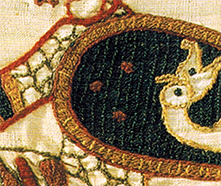

The three red dots on the shield don't really look like buckles, but the arrangement is the same as the 3 gold buckles shown in the Malet Coat of Arms to the right.
William fought with distinction at Hastings, as the following excerpt from Wace's "Roman de Rou" attests:
William whom they call Mallet,
Boldly throws himself among them;
With his flashing sword
Against the English he makes furious onset;
But his shield they clove,
And his horse beneath him killed,
And himself they would have slain,
When came the Sire de Montfort
And Lord William de Vez-Pont
With the great force which they had,
Him they bravely rescued.
There many of their men they lost;
Mallet they remounted on the field
On a fresh war-horse.
When the battle was over, Duke William entrusted William Malet to attend to the burial of the dead English king whose mutilated body had been positively identified by Edith Swannick, Harold's long time common-law wife (Danish-Style marriage, not sanctoned by the church). Edith is more commonly known as Edith "Swan Neck" from the old English: Ealdgyo Swann hnesce, "Edyth the Gentle Swan"). Harold's body was buried under a heap of stones on top of a cliff at Hastings, overlooking the shore that Harold had so bravely defended. William placed a stone on the grave with the epitaph:
"By command of the Duke, you rest here a King, O Harold, that you may be guardian still of the shore and sea".
This burial of Harold was only temporary and the body was later re-buried at Harold's Abbey at Waltham.
The entire story of the Norman conquest of England is told by the aforementioned Bayeux Tapestry, and the whole thing is explained in the following video, posted on the "Lindybeige" channel on YouTube:
"The Bayeux Tapestry – all of it, from start to finish"
Here's an animated version with no dialogue created by students at Goldsmiths College under the direction of David Newton:
"The Animated Bayeux Tapestry"
Here is s re-enactment of the battle of Hastings, provided by "Alex the History Guy":
"Battle Of Hastings Reenactment 2024"
After the conquest William's English holdings were greatly increased, principally in the Danelaw, as English lands were taken from their English owners and handed over to Norman Barons.
"Honour of Eye", Eye, Suffolk
 William Malet built a Motte and Bailey Castle in Eye, Suffolk shortly after the conquest, and it became the seat of extensive holdings known as the "Honour of Eye". Nothing remains of the original castle. The above engraving shows a view of the castle motte c. 1818. The windmill atop the motte was built in 1561-2; the castle having fallen into disrepair and demolished sometime prior to that.
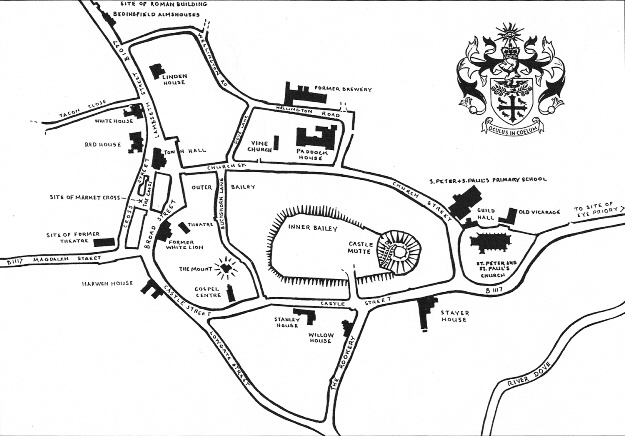 The above image shows the layout of William's castle at Eye. The Honour of Eye was a widely scattered grouping of manors and land holdings spread over eight counties, and was one of the largest estates in England after 1066. The bulk of the land was in Suffolk and Norfolk and before 1066 had been the estate of Edric of Laxfield.
William was dead at the time of the Domesday survey in 1086, but the holdings at that time of his son Robert and of his wife ("Robert Malet's Mother") give a good indication of the extent of his estates. The Honour of Eye, now held by William's son Robert Malet, comprised land in 137 parishes in Suffolk, 35 in Yorkshire, 22 in Norfolk, 6 in Lincolnshire, 4 in Essex, 2 in Nottinghamshire, 1 in Rutland and 1 in Surrey, although the size of the individual holdings ranged from a few acres to entire parishes.
By the Domesday assessment of caracates, borates, woodland and acres the total area must have been at least 75,000 acres, of which 47,000 were in Suffolk. Robert Malet was the second largest landowner in Suffolk, after the Abbot of St Edmundsbury. The Suffolk holdings lay in 27% of the total number of parishes, mainly in High Suffolk and the coastal Sandlings. It has been suggested that the term "High Suffolk" may have derived from "Eye Suffolk", the area of the Honour. Eye with its castle, church, priory and market was the administrative centre of the Honour. The annual income from these English lands is estimated to be about £600, which in today's money (2017) can reasonably be estimated to be in excess of £500,000. It is likely that Duke William conferred these estates on William partly because of his loyalty and skill in battle, but also because of his prior connections with his Danish "cousins" there.
William married Hesilia Crispin by whom he had at least two sons Robert and Gilbert, and one daughter Beatrice. Robert and possibly Gilbert, along with their uncle Durand, accompanied their father at the battle of Hastings.
William was made Sheriff of York and granted considerable lands in Yorkshire following the building of the first Norman castle there in 1068 (the mound now supports 'Clifford's Tower', shown below in 2015).

He and his fellow captains Robert Fitz-Richard and William of Ghent, with 500 picked knights had to fight off a local revolt headed by Edgar the Atheling; this in or shortly after January 1069. Robert Fitz-Richard and many of his men were killed and it was only by the timely arrival of King William that the City was saved. The natives remained restless and had another token go as soon as King William left but were quickly put down. The troops were strengthened and another castle built on the other side of the river from the original but notwithstanding, in September 1069 William, his wife and two of his children were captured by a combined force of Danes and English under Sweyn of Denmark supported by Earls Waltheof and Gospatric and the Northumbrians, when York fell to them after a terrible fight.
This led to King William ordering the burning and killing of everything in the north "the Harrying of the North", and Domesday even 16 years later records most of northern England as still being waste and uninhabited.
William Malet, his wife and two children must have been released some time later and he retained most of his lands, apart from those in Yorkshire which came with the office of Sheriff and had been taken from him. At some point the King awarded William the appellation of "Princep", and in the Charter granted by the King to the church of St. Martin le Grand his signature appears as "Wilielmus Malet Princep". In the context of the times, Princep would likely have been interpreted as "leader, or chief".
William is believed to have died fighting "Hereward the Wake" in the Fens near Ely Cathedral which lies between South Lincolnshire, Cambridgeshire, and Norfolk (all in the middle of the Malet holdings) in 1071. The Domesday book records that
"...He went into the marsh", and that "...he went on the King's service, where he died".
William is generally accepted to be the progenitor of many of the various branches of the Malet family (those that can trace their lines back that far), both in England and in France. The descendants of Durand continued to hold lands in Lincolnshire, and are recorded in Irby on Humber up to the 16th century.
Sources:
- Hart, Cyril, "William Malet and his Family", Anglo-Norman Studies XIX pp. 123-165.
- Keats-Rohan, K.S.B. "Domesday Book and the Malets: Patrimony and the Private Histories of Public Lives", Nottingham Medieval Studies 41 [1997] pp. 13-56.
- Paine, Clive, "The History of Eye", Eye Press, Diss, Norfolk 1993.
- Powell-Smith, Anna. Open Domesday.
- The National Archives (UK), Currency Converter
Author:
Bob Mallett
Ottawa, Ontario, Canada
November 30, 2025.