Malet of Enmore, Somerset
The first Malet associated specifically with Enmore is Baldwin born c. 1122. He is thought to have been the second son of Robert Malet c. 1090, the first Malet to have held the honour of Curry Mallet. It must be stated that we have no documentation that specifically proves this, but there is enough circumstantial evidence to allow us to conclude that he was part of the same family.
The Enmore line has some members who warrant special mention:
- Sir Baldwin, Knight of the Body of Henry IV (1399-1460) who married the daughter of the soldier Sir Thomas Trivett, noted for his exploits during the Hundred Years War. Sir Baldwin was summoned to the Great Council held in the second year of the reign of Henry IV.
- Thomas (d. 1503) married Joan the daughter of Sir William Wadham de Meryfield, who founded Wadham College, Oxford University.
- Sir John who was a Knight of the Bath (knighted at the Coronation of James I) and High Sheriff of Somerset in 1601, married Mary the daughter of Sir John Popham, Chief Justice of England.
After 12 generations, the Enmore line ended with "the Malet heiress", Elizabeth Malet. She was the sole heir to the Enmore estate after the death of her father John Malet and was much desired by the men of the Court (both for her looks and her money). She had a very considerable annual income, thought to have value of £2000 to £2,500 (£228,000 to £285,000 in 2017) per year from the family estates. She married John Wilmot, Earl of Rochester, and became Countess of Rochester.
The Enmore Estate was no longer in Malet hands after Elizabeth's marriage in 1666, but two cadet branches carried on. Malet of St Audries in Somerset, and Mallet of Ash in Devon.
John Mallet of Enmore 1628 – 1656
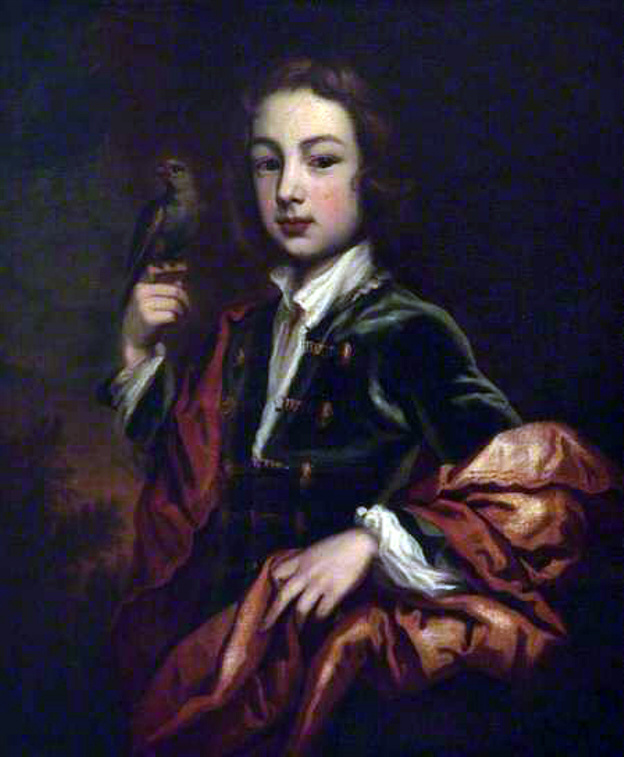
John was the last male member of the Enmore line. He died quite young, about 30 years old. He is pictured here as a very young man. His only child Elizabeth, 5 years old at the time of his death, became the sole heiress of the Enmore Estates.
Baldwin Malet's Accession to the Enmore Estates
As stated above, we have no direct evidence of Baldwin Malet's birth, but references were made in legal documents in 1166 referencing Baldwin Malet as the son of Hugh Fichet, leading Sir William Pole, and subsequently Arthur Malet writing in "Notices of an English Branch of the Malet Family" to develop a theory, without further evidence, that Hugh Fichet might have been a 'Malet' who had changed his name because he fell out of favour with the Crown.
G.E.G. Malet, writing in "The Origin of the Malets of Enmore", published 1938/9 in the Genealogist magazine, suggested that there were a number of reasons for discounting this name change theory, and pointed out that the Latin word 'filius' could be interpreted as 'son', 'son-in-law' or 'stepson'. He proposed a new theory that Baldwin's wife 'Emma might have been the daughter of Basilia, Hugh Fichet’s wife, which would have made Baldwin the son-in-law of Hugh Fichet. But the position taken both in the de Neville family documents and by Arthur Malet is that Emma was Emma de Neville, and that the marriage of Baldwin and Emma only occurred c. 1171, a year prior to the birth of their only son Sir William Malet and after the documents regarding Hugh Fichet in 1166.
A much simpler explanation is that Basilia was first married to Robert Malet, probably as his 2nd wife, had one son Baldwin by him, and only married Hugh Fichet after Robert’s death (Est.1154). None of the references to Hugh Fichet as father of Baldwin pre-date Robert Malet’s death, making it highly likely that Baldwin was Hugh Fichet’s stepson, rather than son or son-in-law. Enmore was within the Barony of Curry Mallet estates (Domesday Book), and Basilia appears to have resided there as Dowager Baroness after Robert Malet’s death. It seems that Hugh Fichet may have joined her there after their marriage, but it is probable that Basilia, not Hugh Fichet, was the one with rights to the residence, perhaps for her lifetime, with Enmore and some land from the main Curry Mallet estate being passed to Baldwin after his mother’s death, as part of Robert Malet’s or her Will.
"La Triste Héritière" (The Sad Heiress)

It was small wonder that Gramont described her at this period as "the melancholy heiress" (La Triste Héritière)!
Elizabeth was only 13 years old when her grandfather Lord Hawley, and her step father Sir John Warre started shopping her around, looking for a suitable husband for her. Given that she had substantial annual income from the Enmore estate, they knew that she would be in great demand with potential suitors, and they wanted to be sure that she wasn't taken advantage of by someone with no, or little income.
One of those suitors was John Wilmot, 2nd Earl of Rochester. He was not even on the short list as far as Elizabeth's grandfather and step father were concerned, because he had very little income despite his grand title. He had a reputation as a rake, but he was tall and handsome, and very witty.
He was far too attractive for a flirtatious fifteen-year-old to reject out of hand. Moreover, he could write the sort of fashionable, amorous, pastoral poetry that delighted Elizabeth Mallet's girlish heart. Rochester was also a favourite at court, and had the King and others in his corner in his pursuit of Elizabeth.
On May 26, 1665, Rochester abducted Elizabeth Mallet, with hopes of taking her to his estate at Adderbury, and then? It is not certain how he thought this gambit was going to play out, but he was unsuccessful.
Samuel Pepys tells the story:
"Here, upon my telling her a story of my Lord Rochester's running away on Friday night last with Mrs Mallet, the great beauty and fortune of the North, who had supped at White Hall with Mrs. Stewart, and was going home to her lodgings with her grandfather, my Lord Hawly, by coach; and was at Charing Cross seized on by both horse and foot men and forcibly taken from him, and put in a coach with six horses and two women provided to receive her, and carried away. Upon immediate pursuit, my Lord of Rochester (for whom the King had spoken to the lady often, but with no success) was taken at Uxbridge; but the lady is not yet heard of, and the King mighty angry, and the Lord sent to the Tower."

Elizabeth was found in fairly short order and returned to her family. Rochester spent 3 weeks in the Tower of London.
Elizabeth had made it clear to her handlers that she would make her own decision regarding her marriage, and on January 29, 1666 she eloped with Rochester and married him.
Elizabeth (Mallet) Wilmot, Countess of Rochester 1648 – 1681

Elizabeth's marriage to Rochester was a rocky one. He spent most of his time in London, drank heavily and had several mistresses. He died of Syphillis in 1680, and Elizabeth followed him to the grave one year later. Her cause of death is unknown, but given that her husband died of Syphillis, it seems likely she may have contracted that terrible disease too.
John Wilmot, 2nd Earl of Rochester 1647 – 1680

Rochester was substantially responsible for the general reputation of Charles II's Court being totally dissolute. He wrote of the King "He never said a foolish thing nor ever did a wise one". To which Charles replied "My words are my own, my acts are my ministers." Rochester has the dubious distinction of having written some of the most outstanding bawdy verse in the English language. True to his lifestyle, he died in his early thirties, a burnt out shell of a man.
"The Libertine"

Johnny Depp and Rosamund Pike in their roles as John Wilmot and Elizabeth Mallet in the 2004 movie "The Libertine".
Lady Diana Spencer, 8th GGDaughter of Elizabeth Mallet

Sources:
- Malet, Arthur, "Notices of an English Branch of the Malet Family" (1885)
- G.E.G. Malet, "The Origin of the Malets of Enmore", The Genealogists' Magazine Volume 8, No. 6 (June 1939), Page(s) 316-324
- Greene, Graham, "Lord Rochester's Monkey"(1974)
- Johnson, James William, "A Profane Wit" (2004)
- The National Archives (UK), Currency Converter
Author:
Bob Mallett
Ottawa, Ontario, Canada
November 30, 2025.